Bird on Fire

Bird on Fire
Cities are the cradles of human civilization, and they are also the testing grounds for humanity’s future. Over 50% of human beings now live in cities, and that percentage is going to accelerate rapidly as the megacities of the global South grow precipitously over the rest of this century.

At the same time, cities are likely to be the setting of some of humanity’s greatest collective tragedies. At present, approximately 2.8 billion people – roughly 40% of the world’s population – live in coastal cities. These regions, and the cities and people that are located in them, are particularly vulnerable to the multiple impacts of climate change, from sea level rise to ocean acidification and intensified meteorological phenomena like storms and droughts.

If humanity’s collective fate will then in some sense be decided in the world’s cities, which urban areas do we look to if we wish to catch a glimpse of the future, and where do we turn in our attempts to forge some sort of climate justice? Many analysts have answered these interwoven questions by anatomizing cities that are paradigms of ecological sustainability, from places in the developed world such as Amsterdam and Freiburg to Curitiba in Brazil. These cities no doubt offer important lessons about how to green cities, but most people don’t live in such places.

Andrew Ross boldly offers another approach in Bird on Fire. Touching down in Phoenix, Arizona, Ross explores the question of environmentalism in what is arguably the US’s – and perhaps the world’s – least sustainable city. If Phoenix can go green, he reasons, then there really may be hope for humanity in the face of the environmental crisis.

Key to the question of urban sustainability, Ross argues, is the issue of social justice. Ecological salvation, that is, will not come through the invention of some miraculous green technology, or through some new green consumer fad. Against such prevalent approaches, Ross argues that sustainability is first and foremost a question of social justice. Only through efforts to transform our cities into more just and egalitarian places do we stand a chance of forging truly sustainable – in all senses of the term – societies.

Bird on Fire offers many crucial lessons for environmental and climate justice activists. To draw out some of those lessons, Social Text has assembled a group of prominent activist intellectuals to comment on Ross’s important book, as well as an excerpt from the book and a video of a talk that Ross gave at the CUNY Graduate Center. Sandy Bahr is the director of the Sierra Club's Grand Canyon Chapter in Arizona; Kristin Koptiuch is Associate Professor of Anthropology at Arizona State University; Laura Pulido is Professor of American Studies and Ethnicity at the University of Southern California; and Julie Sze is Associate Professor of American Studies at UC Davis.

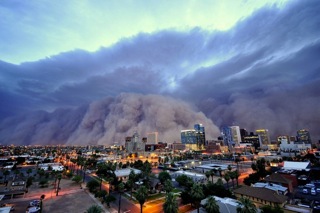
Top image courtesy of danbryant.com.

Introduction: By the Time I Got to Phoenix (Book Excerpt)

For those who prefer history chopped up into neat slices, John McCain's modest concession speech on the lawn of the Arizona Biltmore on November 5, 2008, seemed like a clean cut of the knife. With the economy in a nosedive, it was not just the end of a presidential campaign. The neoliberal era seemed to be over--its reigning troika of deregulation, marketization, and privatization cast into disgrace, along with its most recent fiscal vehicles such as debt leveraging and speculation in finance and land. Nowhere was the devastation more visible than in McCain's hometown. Phoenix had flown highest in the race to profit from the housing bubble, and it had fallen the furthest. Footage of the metro region's outer-ring subdivisions reclaimed by sage grass, tumbleweed, and geckos was as evocative of the bubble's savage aftermath as photographs of the Dust Bowl's windblown soil had been of the Great Depression.>>

Bird on Fire: Response

Andrew Ross has done it again. He's researched something new, and written it up elegantly. In this case, the topic is sustainability, in that most right-wing of cities, Phoenix (Arizona). Ross weaves in a complex set of stories and voices, from right-wing property developers to bureaucrats, environmentalists, environmental justice activists and Native tribes. He begins this book with a simple-yet heretical- observation, a 21st Century version of the Frank Sinatra standard, New York, New York. That is, Ross contends, that if any city can make sustainability matter, it's not the environmentally friendly American cities like San Francisco and Portland, but rather, cities like Phoenix- short on water, defined by sprawl and spawning ground to Goldwater and his ilk. When I first...>>

A City like the Desert

I confess: I drive "a Prius, eat organic and support wilderness preservation." I am under no illusion, however, that doing these things makes my lifestyle sustainable. There is much more to achieving sustainability goals personally and, more significantly, sustainability cannot be a solo act. Bird on Fire drives home that point - environmental sustainability in our communities must be inclusive and it is impossible to achieve without social justice and social sustainability. We can nip around the edges by growing more of our food and "buying local," conserving water, and developing a strong mass transit system, but without a coming together of the haves and have nots, it is really just me driving a Prius. So there really are some key questions...>>

That Which Is Not Inferno, Or, The Pleasure of the Urban Text

Phoenicians starved for their city's self image will find critical satisfaction in Andrew Ross' Bird on Fire. As a Phoenix resident for nearly 20 years, I know all too well how we have long been deprived of the kind of "pleasure of the text" experienced by denizens of New York, Los Angeles, Chicago, Miami, Philadelphia, Las Vegas, and many second or third tier cities, when encountering the myriad representations of their city in film, music, art, popular and scholarly literature.[1] Beyond the evening news, depictions of Phoenix are rare: most famously, the opening scene of Hitchcock's Psycho quickly pans the scant 1960 skyline before the camera zooms into the sordid Westward Ho hotel room where the movie's plot begins; the TV...>>

The Future is Now: Climate Change and Environmental Justice

On one side of town, there would be ecological 'haves,' enjoying access to healthy, morally upstanding green products and services. On the other side of town, ecological 'have-nots' would be languishing in the smoke, fumes, toxic chemicals, and ill-nesses of the old pollution-based economy.[1]  The rich will find their world to be more expensive, inconvenient, uncomfortable, disrupted and colourless; in general, more unpleasant and unpredictable, perhaps greatly so. The poor will die.[2] By focusing on Phoenix and its environmental challenges, Andrew Ross's Bird on Fire broadens our understanding of environmental justice. In particular, the book shows how conceptions of environmental justice have evolved and broadened to include diverse issues, including parkland, transportation, urban design, energy, biodiversity, and climate change. This...>>

Andrew Ross Talks "Bird on Fire" at the CUNY Grad Center

An excerpt from Andrew Ross's Bird on Fire talk, delivered at the CUNY Grad Center on October 28, 2011.Untitled from Social Text on Vimeo....>>